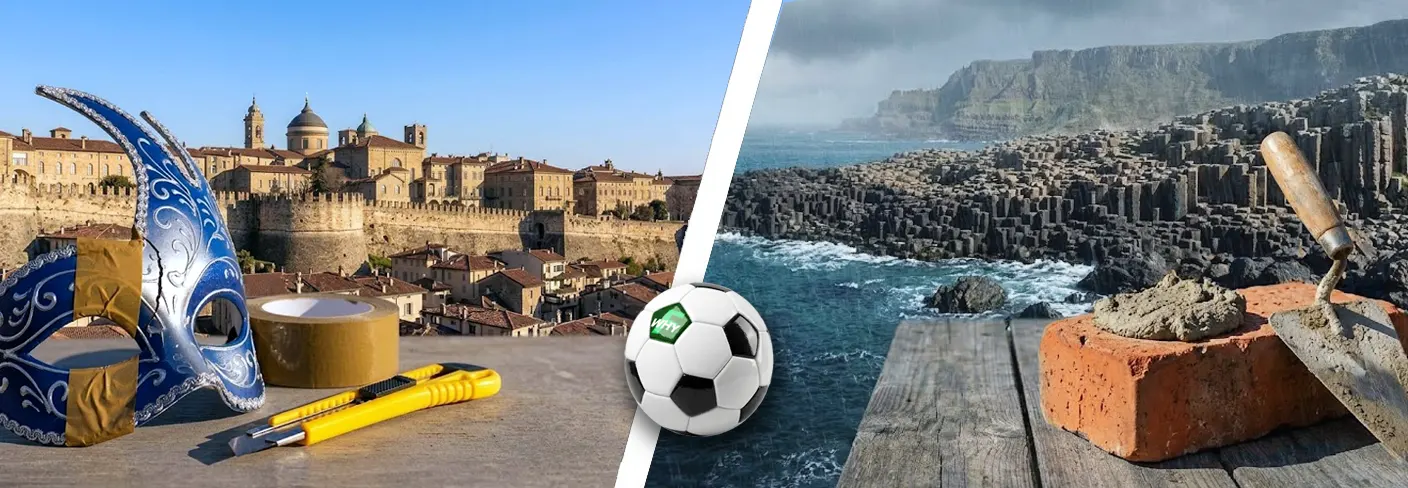
A wounded footballing aristocracy defends its fading dynasty against a stoic, community militia. It is a collision between the desperate need for aesthetic redemption and the stubborn pride of organised suffering. Expect meticulous anxiety to meet unbothered, relentless endurance.
For Italy, this fixture represents significantly more than a play-off semi-final; it is a mandated border crossing to restore institutional credibility after the trauma of North Macedonia and the San Siro collapse. The national side must prove to a fractious public that their meticulous, artisanal patterns can still dismantle a low block. Northern Ireland arrive seeking validation for a different mandate entirely, aiming to prove that community endurance and procedural discipline remain viable at the elite level. The visitors carry the sting of their late Slovakia heartbreak, but view suffering as a legitimate tactical pathway rather than a failure. It is a collision between the wounded aristocrats of craft and the stoic parish militia. Italy will command the possession metrics from the first whistle. Northern Ireland will rely on dead-ball situations to bridge the technical deficit.
Italy: How we will host...
Gennaro Gattuso approaches this fixture carrying the inherited anxiety of recent qualification failures. The manager must insulate his squad from the inevitable crowd panic if an early goal fails to materialise. He intends to manage this through extreme structural familiarity. The tactical blueprint relies heavily on a rehearsed left-sided circuit, with the defenders instructed to overload their flank and feed early crosses. The objective is to secure a lead procedurally, avoiding the chaotic, end-to-end transitions that Northern Ireland will likely attempt to provoke.
Should the visitors bunker down effectively, Gattuso will demand patience over frantic volume. He has prepared a specific anti-crisis protocol for any sudden setbacks or VAR delays. The team will immediately collapse into a rigid shape, refusing to counter-press for three minutes to let the emotional temperature drop. This stoic reset mechanism is designed to prevent the sort of unravelling that defined their last playoff exit. Northern Ireland's expected reliance on deep defending will be met with methodical width rather than desperate central probing.
Northern Ireland: With what we arrive...
Michael O'Neill travels to Bergamo with a clear mandate to weaponise his side's underdog status and weather the inevitable Italian storm. The manager understands that surviving the opening exchanges is a psychological imperative. He intends to frustrate the hosts by deploying a rigid low block, deliberately funnelling Gattuso’s orchestrated left-sided attacks into congested central traffic. The objective is to secure territory incrementally and bank set-piece opportunities.
Should the visitors concede or face a marginal refereeing decision, O'Neill has primed his squad to avoid emotional unravelling. The immediate response will be a mandated three-minute retreat to kill the game's rhythm. They will prioritise procedural discipline over frantic equalisers.
Knowing Italy's anxiety tends to spike against stubborn resistance, O'Neill will rely on rehearsed dead-ball routines and direct channel balls to exploit spaces left by advancing Italian full-backs. It is an exercise in stoic realism, designed to drag a technically superior opponent into a grinding battle of attrition.
First Half. While hope is alive...
The opening exchanges in Bergamo are expected to resemble a procedural audit, with Italy carrying the heavy administrative burden of past qualification failures. The hosts will channel this inherent anxiety into rehearsed, artisanal patterns down the left flank. Alessandro Bastoni is set to step out from central defence, attempting to fix the Northern Irish markers and release Federico Dimarco for early deliveries. Michael O'Neill's side will accept this territorial deficit. They plan to deploy a compact five-man defensive line and wait for their moments.
The visitors will hunt for set-piece leverage, aiming to force Gianluigi Donnarumma into uncomfortable early decisions. A heavy-traffic corner is likely to rattle the Italian six-yard box early on. The hosts will respond by activating a deliberate containment protocol. Donnarumma will dramatically slow the restart cadence to allow the emotional temperature to drop.
Once the panic subsides, Italy's structural scaffolding will take over. Nicolò Barella is projected to freeze the right half-space, initiating a third-man passing sequence that frees Dimarco. A subsequent cut-back will find Davide Frattesi arriving at the front post to secure the opener, making it 1-0.
Northern Ireland will not deviate from their stoic blueprint. Trai Hume will maintain a staggered defensive depth on the right, conceding the half-space cross to protect the byline. However, if Dimarco is forced to cross from too deep, Giovanni Di Lorenzo’s narrow positioning could leave a sprint lane entirely unguarded. The half will conclude with Italy controlling possession, while Paddy McNair hits long diagonals to bank territory.
Second Half. When the stakes rise...
The second half will commence with Italy attempting to raise the tempo through coordinated midfield movements. Frattesi is instructed to time blind-side runs, while the wide attackers alternate their positioning. Northern Ireland will respond by increasing their pressing intensity on backward passes. The visitors know their set-piece volume remains a potent weapon, provided they can properly box out Italian markers at the back post.
As the hour mark approaches and Dimarco’s running output dips, Gattuso is expected to introduce Federico Chiesa. The winger’s arrival will immediately flip the one-on-one hierarchy on Northern Ireland’s left flank. Jamal Lewis will find his recovery pace insufficient to cover both the touchline and the cut-back lane. Chiesa will isolate his man, drive to the byline, and deliver a low ball for Gianluca Scamacca. The central striker will peel off his marker to double the advantage, making it 2-0.
The final quarter will see Northern Ireland escalate their verticality. O'Neill's men will transition to a heavier attacking shape, rotating throw-in routines to crowd the penalty area. A disallowed tap-in for offside will briefly jolt the stadium, prompting Italy to lock into a rigid defensive structure.
The fixture will ultimately be decided by physical and mental attrition. Northern Ireland’s wing-backs will burn their early fuel hunting restarts, leaving their recovery angles blunted. Conversely, Italy’s initial anxiety will be successfully contained by ritualised delays and clear goalkeeping authority, preventing the squad from unravelling into a chaotic, rushed approach.
But it could have been different...
The Blueprint for Ulster Attrition
If Northern Ireland fully embrace a psychology of procedural endurance, their probability of securing an upset could rise from a baseline of twenty percent to a credible thirty-three percent. The pre-match directive must strip away all triumphalism, focusing entirely on a strict 'block, box, basics' mantra. By normalising suffering as progress, the squad becomes a collective of calm storm-builders. They will channel the opposition into wide areas, trapping the ball on the goalkeeper's open foot and securing early set-pieces. The tactical shape remains a rigid five-man defensive line. The right wing-back staggers his depth to avoid over-committing.
As the match progresses into the second quarter, this mental framework manifests as stubborn patience. The visitors absorb pressure and reset their shape methodically. Every safe clearance into the channels is viewed not as a failure of possession, but as a successful adherence to the script. The defensive midfielder anchors the central zone, tracking blind-side runs without being drawn out of position.
Approaching the hour mark, the psychological state transitions to an earned escalation. If the score remains level, the manager introduces a second striker, shifting the structural alignment. The players exhibit collective courage without panic. They rotate throw-in routines and methodically crowd the six-yard box, seeking to weaponise near-post chaos.
The ultimate strategic objective is to compress the game into a procedural grind for sixty minutes, banking restarts and extracting a single, high-leverage contact. It is a testament to the reality that sheer, unglamorous civic discipline can occasionally dismantle the most intricate of aristocratic blueprints.